The launch campaign playbook (Part 2: executing)
The execution side of a real book launch — what you do during the 14 days while the calendar runs, how to respond to surprises, and the post-launch debrief.
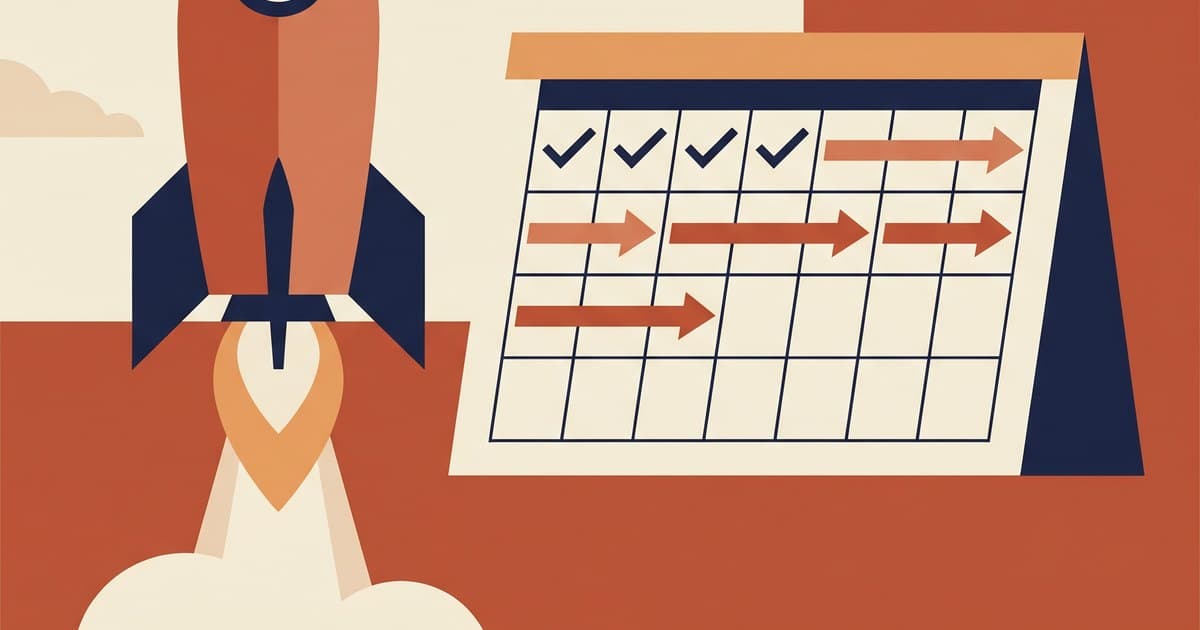
Part 1 was about planning — the work you do in the month before. This is Part 2: what happens during the 14 days once the campaign is scheduled and the calendar is running.
If you did the planning right, most of this is light. You check in once or twice a day, react to what's happening in real time, and spend 80% of your energy writing the next book. Here's the rhythm.
Daily checklist
Every morning during the launch campaign, 5 minutes:
- Open the dashboard. Scan for failure alerts. If there are none, great.
- Check yesterday's published posts. Look at the calendar view filtered to "published" for the last 24 hours. Did everything actually go live? Any unexpected low-reach on a platform?
- Check today's scheduled posts. Open the calendar for today. Anything weird? Any caption that feels off given something that happened overnight?
- Reply to comments and DMs on yesterday's posts. This is the one thing no AI can do for you. Open the Inbox tab, which pulls comments, DMs, and reviews from every platform into one list, and spend 10–15 minutes on actual reader engagement. It matters more than another drafted post, and one inbox means you're not checking three apps during a launch.
Total: 20–30 minutes per day during the campaign. Not 3 hours.
Reacting to unexpected traction
Sometimes a post takes off. One of your teaser reels hits 50k views when you expected 5k. One of your carousels gets shared by a community account you've never heard of. Here's what to do:
1. Don't over-react. Your tendency will be to immediately write a follow-up, squeeze more juice out of the moment, jam more content into the platform. Don't. You have the campaign already running. Trust it.
2. Do one follow-up, but strategically. On the platform that popped, post one additional piece of content that leans into what worked. If your enemies-to-lovers tension reel hit, post a quote card the next day that escalates the same angle. Don't go back to the same well four times.
3. Make sure your short link is everywhere. If traffic is coming, you want the Amazon link (or your preferred distributor link) prominently placed. Check your profile bio, your pinned post, your campaign's day-14 launch post.
4. Write the follow-up by hand, not AI. Moments that pop need a human in the loop. AI-drafted posts are for scale and rhythm; moment-reactive posts are for authenticity. Write it yourself.
Reacting to failed posts
If a post fails — which happens; Instagram disconnects, TikTok rejects a video for a content policy issue, a platform rate-limits — you get an email within 15 minutes. Here's the triage:
1. Read the email. The failure reason is specific. Your Instagram account disconnected. Your TikTok video exceeded the duration limit. The image was too large.
2. Fix the root cause first. If an account disconnected, reconnect it before hitting retry. If a video was rejected, either shorten it or swap it out — retrying the same failing upload just fails again.
3. Hit retry. One click from the failure email. The post goes through the platform again with your fix applied.
4. Check if it was a one-off or systemic. One failed post = probably a transient glitch. Three failed posts in a row on the same platform = something structural, usually an account disconnect you need to fix.
Reacting to silence
Sometimes the campaign just... doesn't land. Engagement is flat. Pre-orders aren't moving. You're doing the work and the response is quiet.
Two responses:
1. Stay the course for day 14. The launch-day post is the single highest-converting moment of the campaign. Don't abandon the rest of the schedule because the pre-launch lead-up was quiet. Readers wait until books are available; pre-orders and waiting-to- buy are different psychology.
2. Make launch day bigger. If pre-launch was quiet, over- invest in launch day. Write a personal, from-the-heart post by hand (not AI) about finishing the book. Post it on every platform. Go live on Instagram or TikTok for 15 minutes and read the first page. The quiet pre-launch is actually setting you up — launch day is when the conversion happens anyway.
The "something happened in the world" post
Sometimes during your 14-post campaign, something unrelated happens that your readers care about. A big genre event. A community upheaval. A cultural moment that relates to your themes.
You don't have to comment. But if you want to:
- Pause tomorrow's scheduled post for the platform where the moment is unfolding. Open the calendar, find the post, click Pause.
- Write the real-time post by hand. AI is the wrong tool for this.
- Publish it, then unpause the scheduled post for the day after. Let the momentary post have its own day.
Don't try to weave the moment into your launch campaign. They're different energies.
The launch day
Day 14. The book is live. Your last scheduled launch post went out at your peak engagement time.
That morning:
- Post a personal note by hand on your primary platform — what this book meant to you, one sentence of thanks to readers, the link. Not AI. Not from a template. The one human moment of the whole campaign.
- Go live if you can. Fifteen minutes reading the first chapter, answering questions, celebrating. Instagram, TikTok, or YouTube live — whichever platform you're most comfortable on.
- Check and reply to every comment and DM that day. This is the highest-reward engagement work of the whole campaign.
That's it. Book is launched.
The post-launch debrief
Day 15 onwards, before you move on to the next project, spend 30 minutes reviewing:
1. Which posts worked? Sort the campaign by engagement. Which 3 posts outperformed? Save them — the patterns there will inform your next launch.
2. Which posts flopped? Sort by low engagement. Which 3 posts underperformed? Was it the time slot, the platform, the content type, the caption angle? Note what to avoid.
3. Did any platform outperform? If TikTok dramatically outperformed Instagram for this book, next launch should weight toward TikTok. The data is live on the dashboard; use it.
4. What broke that shouldn't have? Account disconnections, failed posts, account warnings — anything that needs investigation before the next campaign.
5. What did the campaign earn? Pre-orders, day-1 sales, waitlist signups, newsletter bumps. Match effort to return. If the 14-post campaign drove 40 pre-orders and $500 of day-1 revenue, that's a known payback next time.
Save this debrief. Three launches in, you'll have enough data to know your own patterns better than any generic launch playbook.
What NOT to do after the launch
- Don't extend the campaign past day 14. The post-launch energy is real, but stretching a launch campaign to 21 or 28 days mostly just dilutes.
- Don't start a new campaign immediately. Give your audience two weeks of breathing room before you ask for attention again.
- Don't pivot to "now about Book 5." Your readers just bought Book 4. Let them read it before you pitch the next one.
What to do next
- If you're running a tight launch and want format-specific tactics: TikTok-only campaign, carousel-only campaign, or video-only campaign.
- If the launch just wrapped and you're about to do the debrief, the backlist reactivation guide is a good next step — it shows how to turn launch-day momentum into long-tail returns on your earlier books.
- If you're not launching soon but want to keep posting anyway: templates for evergreen content keep the social presence alive without another campaign.
Read next
The launch campaign playbook (Part 1: planning)
The planning side of a real book launch campaign — decisions you make in the month before so the two weeks around the launch run themselves.
Mar 17, 2026 · 7 min read

Running an image-only campaign
The lowest-lift batch in the tool: a run of single images in your brand look, captioned per platform, dropped into your queues. Here's the full walkthrough, Look check to publish.
Sep 5, 2026 · 5 min read

Backlist reactivation: making your older books work again
A backlist campaign is the highest-ROI social work most authors never do. Here's how to plan and run one — turning readers of book 1 into readers of book 7.
Apr 18, 2026 · 6 min read